Autonomous AI Agents for Construction Carbon Reporting
Fuel dockets, concrete delivery notes, equipment hire invoices, waste manifests, steel receipts, subcontractor claims - a tier-two builder running five concurrent projects generates thousands of emission-relevant documents per quarter. Autonomous AI agents can collect, process, and verify that data overnight so your team reviews results in the morning instead of chasing paperwork for weeks.
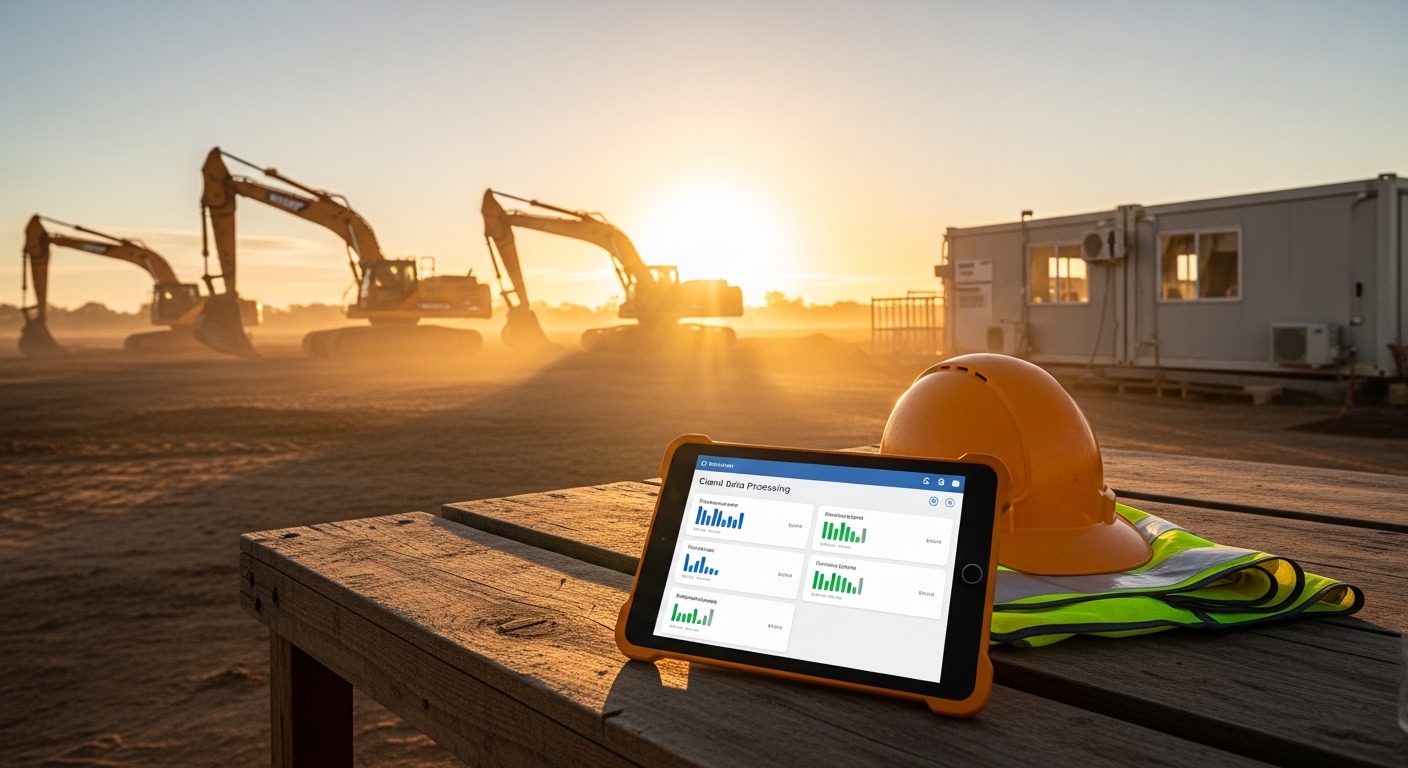
Think about what lands on a construction sustainability manager's desk in a single quarter. Fuel card CSV exports from Motorpass. Handwritten bowser dockets from mobile diesel deliveries. Electricity bills for site compounds. Generator fuel logs. Equipment hire invoices with fuel charges buried in line items. Concrete delivery notes listing cubic metres and mix codes. Steel delivery receipts in tonnes. Timber purchase orders. Waste disposal manifests from skip bin providers. Water consumption records from temporary site connections. Refrigerant top-up logs from site HVAC. Freight invoices for material deliveries. And subcontractor claims that bundle labour, equipment, and fuel into a single dollar figure with no breakdown.
Multiply that across four or five concurrent projects, each with their own site admin, their own filing habits, and their own pile of paperwork - and you start to understand why data collection, not calculation, is where 60-80% of reporting effort goes in construction.
Australia's construction industry generates over $630 billion in annual income across roughly 462,000 businesses. It accounts for approximately 18% of national greenhouse gas emissions - between 30 and 50 million tonnes of CO2-e per year from materials alone, according to the Clean Energy Finance Corporation. Add diesel, site power, waste, and transport, and the numbers climb further. ASRS Group 2 mandatory climate reporting kicked in from July 2026, and plenty of tier-one and tier-two builders fall squarely within scope. NGER has been catching the larger contractors for years.
The question isn't whether construction companies need to report their emissions. It's whether they can physically collect and process the sheer volume and variety of source documents their operations generate, to the quality level regulators expect, in the time available. We think autonomous AI agents are the only practical answer for an industry where data collection alone can consume months of effort per reporting cycle.
The Construction Data Collection Problem Is Different
Every industry struggles with carbon data collection. But construction has a unique combination of factors that makes it significantly harder than most.
First, there's the sheer volume and variety. It's not just fuel. A mid-size civil contractor running five concurrent projects generates thousands of emission-relevant documents per quarter: fuel card exports, bulk diesel delivery dockets, mobile bowser receipts, site electricity bills, generator fuel logs, concrete delivery notes (in cubic metres, not tonnes), steel delivery receipts (in tonnes, or linear metres, or individual counts), timber purchase orders, aggregate and gravel delivery dockets, chemical purchase records, waste disposal manifests from skip bin and tip truck providers, water consumption records, equipment hire invoices with fuel charges buried in line items alongside mobilisation fees, refrigerant service records for site HVAC and cold storage, freight and haulage invoices, and subcontractor claims. Each of those is an emission source. Each needs different data extracted. Each uses different units.
Second, there's the format chaos. Fuel card providers like Motorpass and FleetCard issue digital CSV exports. Bulk diesel suppliers send PDF invoices. On-site bowser deliveries generate handwritten dockets - and if you've ever tried to read a diesel docket filled out by a machine operator wearing gloves in 38-degree heat, you know exactly how "clean" that data is. Concrete suppliers send delivery notes in completely different formats from steel suppliers. Waste companies use yet another format. Some suppliers email Excel spreadsheets. Others send scanned PDFs. A few still send photos of handwritten receipts via text message, which end up forwarded to a project manager's email inbox.
Third, the data comes from everywhere. Site managers have their own files. Procurement has the purchase orders. Accounts payable has the invoices. Subcontractors hold their own fuel and material records. Suppliers send documents to whatever email address they have on file. The sustainability team is expected to collect all of it from all of these people, for all projects, every reporting period. This chasing and collation - not the actual emissions calculation - is where most of the time goes.
Fourth - and this is the one that keeps catching people - construction sites are temporary. A project spins up, operates for 6 to 36 months, and shuts down. The "facility" moves. The people move. The documentation either follows them into a new project folder or gets archived somewhere nobody remembers. Under NGER section 9, a construction project with operational control can be a reporting facility. But the facility's data lives across multiple systems, multiple people, and multiple physical locations that don't exist anymore by the time the report is due on 31 October.
We've written about what makes construction emissions reporting structurally harder in detail elsewhere. The short version: if you're trying to do this with spreadsheets and a part-time sustainability analyst, you're going to miss data, double-count other data, and produce a report that won't survive an audit.
How Autonomous AI Agents Handle Construction Documents
An autonomous agent for construction carbon accounting works differently from a standard document processing tool. It doesn't wait for someone to upload files one at a time. It connects to wherever your project teams store documents - a shared OneDrive folder, a SharePoint site per project - and monitors for new files on a configurable schedule. Every fifteen minutes, hourly, daily - whatever suits the project's document flow.
When a new document lands in the "Project 4821" folder at 2am because a site admin uploaded it after reconciling the day's paperwork, the agent picks it up. No human intervention needed. It reads the document, identifies what it is, and starts extraction.
But the cloud folder isn't the only intake channel - and this is critical for construction. Each project can have its own email address with an authorised sender list. Your concrete supplier can email their delivery notes directly to that address. Your fuel card provider's automated reports land there. Your waste disposal contractor sends their manifests there. Subcontractors can email their invoices directly instead of your team having to chase them for weeks. The agent processes email attachments the same way it processes folder uploads. This alone can cut weeks off the data collection timeline, because you're no longer waiting for your team to manually collect documents from dozens of suppliers across every project.
The agent handles the full range of construction document types. For a fuel card CSV export, it pulls date, litres, fuel type (diesel, unleaded, LPG), vehicle or equipment ID, and site allocation. For a concrete delivery note, it extracts cubic metres, mix code, and delivery location. For a steel receipt, it pulls tonnes, product type, and supplier. For a waste disposal manifest, it identifies waste category, tonnage, and disposal method. For an equipment hire invoice with embedded fuel charges, it separates the fuel line items from the hire charges. For a handwritten bowser docket - and here's where the AI earns its keep - it uses vision understanding to read the handwriting, identify the fuel quantity, and flag its confidence level. A cleanly written "340L Diesel" in block capitals gets a high confidence score. A barely legible scrawl that might say "340" or "390" gets flagged for human review.
Each extraction carries a confidence score. That score isn't cosmetic. It's the mechanism that makes the whole system trustworthy. When a project manager reviews the morning's processed documents, they don't need to check every single line. They check the flagged items - the low-confidence extractions where the agent is unsure, the potential duplicates, the anomalies where a site apparently consumed three times its normal diesel volume on a Tuesday.
Then the agent applies emission factors. And for construction, this is where the detail matters.
Emission Factor Matching for Construction Data
Construction emissions span all three scopes, and each one has different data requirements and different factors.
Scope 1 is mostly diesel, but not exclusively. The NGA Factors 2025 give diesel oil a Scope 1 factor of approximately 2.7 kg CO2-e per litre with an energy content of 38.6 GJ per kilolitre. Petrol sits at around 2.3 kg CO2-e per litre. LPG is roughly 1.6. An autonomous agent needs to correctly identify which fuel type appears on each document and apply the right factor - not assume everything is diesel because the project is a civil construction site.
But there are subtleties. The NGA Factors distinguish between on-road and off-road usage for some fuel types. Stationary combustion in generators uses a different factor pathway than mobile combustion in vehicles. A construction site has both. The bulk diesel going into a generator is stationary energy. The diesel going into an excavator is transport energy. They have different NGER categories (Category 2 versus Category 15, broadly). An agent that doesn't make this distinction will calculate roughly correct total emissions but assign them to the wrong NGER category, which is a compliance problem.
Scope 2 for construction is primarily site electricity. Temporary construction power connections, permanent power once it's available, and generator-supplied electricity (which actually falls under Scope 1 as stationary combustion, not Scope 2 - a common misclassification). The NGA Factors for Scope 2 grid electricity vary dramatically by state. A construction site in Victoria (0.78 kg CO2-e per kWh) generates nearly four times the Scope 2 emissions as the same project in Tasmania (0.20 kg CO2-e per kWh) for identical electricity consumption.
An autonomous agent that's built for Australian construction knows to apply state-based factors, not the national average (0.62). It identifies the site location from the document or the project metadata, matches it to the correct state grid factor, and calculates accordingly. This isn't a small difference - using the national average instead of the Victorian factor on a project consuming 500,000 kWh per year gives you 310 tonnes CO2-e instead of 390 tonnes. That's an 80-tonne error. On a single site.
Scope 3 is where construction gets genuinely difficult. Concrete, steel, and aluminium alone account for over 70% of building embodied carbon, according to the Green Building Council of Australia. But the emission factors for materials depend on the specific product - a tonne of general-purpose cement has a different factor than a tonne of supplementary cementite material with fly ash content. Steel from an electric arc furnace has a different factor than blast furnace steel. If your supplier provides an Environmental Product Declaration (EPD), that's the best data. If they don't, you're using generic industry averages.
This is where a multi-tier matching approach matters. The agent doesn't just look up "concrete" in a flat table. It first checks whether this exact supplier product has been matched before (a learned mapping from previous processing). If not, it tries a direct name match against the NGA database. Then alias matching - because "GP concrete 32MPa" and "general purpose 32 megapascal concrete" are the same thing but look completely different on paper. Then AI-assisted context matching that understands construction terminology. Then fuzzy matching as a fallback. Each tier carries a different confidence level, and that confidence flows through to the final emission figure.
We're honest about this: Scope 3 for construction remains the hardest category because material supplier data quality varies enormously. An autonomous agent can process delivery dockets and purchase orders to identify materials and quantities. But whether the resulting emission figure is accurate depends on the emission factor source. If a supplier provides an EPD, that's high-quality data. If they don't, you're using generic industry averages with 30-40% error margins. The agent flags this distinction so your team knows which figures are solid and which are estimates.
Duplicate Detection Across Sites
Here's a problem that construction companies almost never budget for: duplicate invoices.
It happens constantly. A subcontractor sends their fuel invoice to the project manager. The project manager forwards it to the sustainability team. The subcontractor's accounts department also sends it to your accounts payable. The same invoice gets uploaded to the project's shared folder and separately to the central finance folder. Now it's been counted two, three, sometimes four times.
On a single project this is annoying. Across five or ten concurrent projects, each with their own document management practices and their own project managers who all think they're being helpful by forwarding things, it's a data integrity disaster. Industry estimates suggest 5-12% of emissions source data can be duplicated in organisations with decentralised document management - and construction is about as decentralised as it gets.
An autonomous agent catches this by comparing key fields across all processed documents - invoice numbers, dates, amounts, supplier names, fuel quantities. If two documents from different project folders contain the same Motorpass fuel card transaction from the same date for the same litres of diesel, the agent flags it as a likely duplicate and excludes it from the calculation until a human confirms.
This matters for NGER thresholds. If your corporate group is hovering near the 50 kt CO2-e or 200 TJ boundary, duplicated fuel data could push you over - or under, if the duplicates were inflating a figure that's actually below threshold. Either way, the number needs to be right. The Clean Energy Regulator's compliance team isn't interested in explanations about filing systems.
Infrastructure Project Ratings and Tender Requirements
Beyond regulatory reporting, construction companies increasingly face carbon disclosure requirements from a different direction: project ratings and government procurement.
The Infrastructure Sustainability Council's IS Rating Scheme has been used across more than $300 billion worth of Australian infrastructure projects. It requires detailed carbon measurement and reporting. Green Star Buildings v1.1, effective from 1 May 2026, requires a minimum 10% embodied carbon reduction compared to a 2020 baseline, with a 40% target by 2030. And from July 2026, Commonwealth office construction projects over $15 million must achieve a minimum 4 Star Green Star certification.
State government tenders increasingly include ESG evaluation criteria. NSW, Victoria, and Queensland infrastructure agencies are all moving toward mandatory carbon reporting in procurement processes. If you can't quantify your project's emissions with auditable data and clear methodology, you lose points. You lose tenders.
An autonomous agent that's processing your fuel dockets, electricity bills, and material delivery notes in real time doesn't just give you NGER compliance. It gives you a project-level emissions profile that you can submit alongside a tender response or an IS Rating application. The data's already there. It's already verified. It's already linked to source documents. You're not scrambling to retrospectively reconstruct emissions from a project that finished nine months ago.
We should be honest here, though - IS Ratings and Green Star also require qualitative sustainability performance data that goes well beyond carbon numbers. An autonomous agent handles the quantitative side. The governance, stakeholder engagement, and sustainability management plan elements still need human expertise. This isn't a complete solution. It's the quantitative foundation that everything else sits on.
The Review Workflow: What Changes Day-to-Day
The practical shift for a construction sustainability lead is this: instead of spending days collecting and entering data, you spend your morning reviewing what the agent has already processed.
The agent categorises its output into three buckets. High-confidence extractions - clean fuel card CSVs, digital electricity bills, typed invoices from major suppliers - flow into a review queue already calculated into project-level emissions totals. These are the 80-90% of documents that are straightforward. Low-confidence items get flagged for attention: a handwritten bowser docket where the quantity is ambiguous, a concrete delivery note where the mix code doesn't match any known factor, a material description the system hasn't encountered before. And potential duplicates get held separately - the same document uploaded by two different project managers from two different project folders, or the same fuel card transaction appearing in both a project folder and a supplier email submission.
The review process also catches anomalies. If a site's diesel consumption spikes 40% above its rolling average, the agent flags it. That might be legitimate - a new phase of earthworks started - or it might be a data entry error at the fuel pump. Either way, a human looks at it before it enters the emissions ledger.
The result is that your sustainability team's role shifts from data collection and data entry to data governance and sign-off. The hours previously spent chasing documents, opening PDFs, and transcribing figures into spreadsheets get replaced by a focused review of exceptions and edge cases.
The Honest Gaps
We won't pretend this is a solved problem for every situation construction throws at you.
Subcontractor emissions remain tricky. If a subcontractor brings their own equipment and their own fuel, those emissions sit in your Scope 3 (Category 1 - purchased goods and services) rather than your Scope 1. But many construction contracts bundle labour, equipment, and fuel into a single line-item price. The agent can flag these bundled invoices, but extracting the fuel component requires either the subcontractor to provide a breakdown or an estimation method. Neither is perfect.
Cross-project fuel allocation is still partially manual for shared equipment. An excavator that works on Project A on Monday and Project B on Tuesday might refuel once on Wednesday. The fuel card receipt shows one transaction. Allocating it correctly to two projects requires either telematics data or manual timesheets, and most construction companies don't have the former integrated with their carbon accounting yet. Percentage-based allocation rules are one approach, but it's an area where engineering judgement is still needed.
And remote sites with poor connectivity create gaps. If a project team in outback Queensland can't upload documents for two weeks because the satellite internet is down, those documents get processed two weeks late. The agent handles the backlog fine once documents arrive, but the real-time visibility only works when documents actually make it to the cloud folder.
The Regulatory Clock
NGER reports are due 31 October. No extensions. The Clean Energy Regulator has shown through actions like the Beach Energy enforceable undertaking in July 2025 that data quality failures have real consequences. Beach didn't make up numbers. They "inadvertently misstated" them. The result was three years of mandatory reasonable assurance audits and a public enforceable undertaking.
ASRS Group 2 reporting started from July 2026. Group 3 from July 2027. Many construction companies hit both NGER thresholds and ASRS criteria. A corporate group consuming 200 TJ of energy across its projects - that's roughly 5.2 million litres of diesel equivalent - triggers NGER. And if you're a listed entity or meet the Group 2 size thresholds, you're reporting under AASB S2 as well.
The companies that have their document processing automated before the next NGER deadline aren't just saving time. They're building the data infrastructure that ASRS, NGER, IS Ratings, Green Star, and government tender requirements all draw from. One dataset. Multiple outputs. Audit trail built in from the start.
Construction moves fast. Reporting deadlines don't wait. The question for every tier-one and tier-two builder in Australia right now is whether they can physically process the volume of emissions data their operations generate, to the quality level their regulators expect, in the time they have available.
If the answer is no - and for most, it still is - then autonomous AI agents aren't a future possibility. They're a present necessity.
Related reading:
- Carbon Accounting for Construction Companies in Australia - the full guide to Scope 1, 2, and 3 emissions, NGER facility definitions, and where builders get it wrong
- Embodied Carbon in Buildings and Construction - concrete, steel, aluminium factors, EPDs, and the NCC 2025 voluntary benchmarks
- NGER Reporting Thresholds 2026 - facility versus corporate thresholds, back-of-envelope calculations, and the Group 2 ASRS pipeline
- ASRS Group 2 Reporting Requirements - what Group 2 entities need to know and the lessons from Group 1's first year