Carbon Accounting for Retail Supply Chains in Australia
For Australian retailers, Scope 3 dominates - often 90% or more of total emissions. Purchased goods, upstream transport, refrigerant leaks, multi-site electricity, and end-of-life treatment of products all need accounting. Here's how to actually do it without drowning in supplier questionnaires.
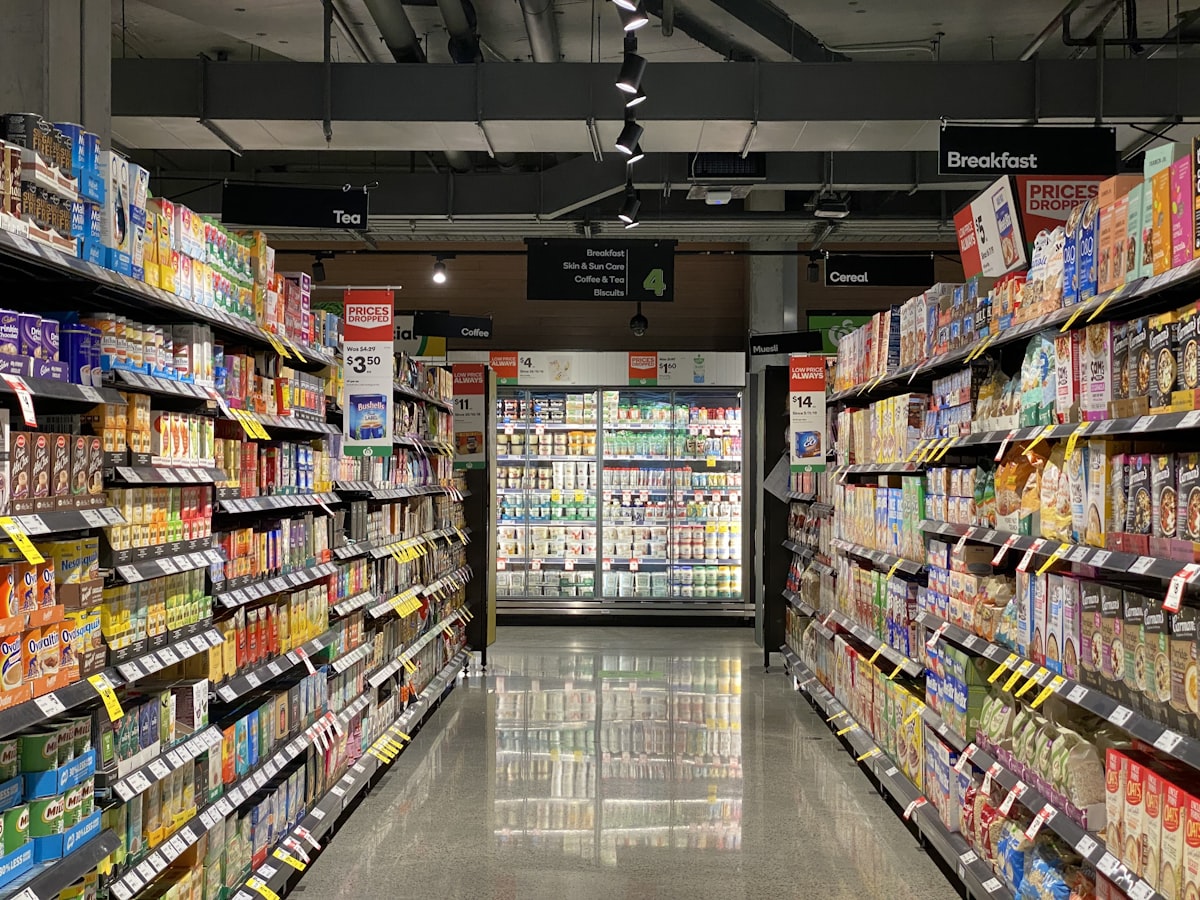
Woolworths Group reported 34 million tonnes of CO2-e in Scope 3 emissions for FY2024. Their combined Scope 1 and Scope 2? About 1.5 million tonnes. That means roughly 96% of their carbon footprint sits outside their direct operations - in farms, factories, freight companies, packaging suppliers, and the bins where customers throw away their products.
Coles is in a similar spot. Around 19 million tonnes of Scope 3 against less than a million tonnes of Scope 1 and 2.
These aren't outliers. This is what the emissions profile of a retailer looks like. And with ASRS Group 2 mandatory reporting now live for financial years starting 1 July 2026 - and Scope 3 becoming mandatory from the second reporting period - every mid-market and large Australian retailer needs to figure out how to measure a supply chain carbon footprint that dwarfs their own operations. Most haven't started.
The Categories That Actually Matter for Retail
The GHG Protocol lists 15 Scope 3 categories. Retailers don't need to lose sleep over all of them. But five will dominate your inventory, and getting them wrong (or ignoring them) will undermine your entire disclosure.
Category 1: Purchased Goods and Services. This is the big one. For grocery retailers, it's the food - agriculture, processing, packaging. For fashion, it's the textiles and manufacturing. For hardware chains, it's steel, timber, concrete. Woolworths' data shows Category 1 alone accounts for about 80% of their total Scope 3. That's 27.7 million tonnes from purchased goods against 34 million total.
The hard part isn't knowing this category matters. It's getting data that means anything. Spend-based emission factors - where you multiply your procurement spend by an industry-average factor - will get you a number. But it won't get you a useful number. A $50 million dairy procurement line could have wildly different emissions depending on whether your supplier is in Gippsland or New Zealand, running methane capture or not, using renewable electricity or grid power. Spend-based estimates don't capture any of that.
Category 4: Upstream Transportation and Distribution. Every pallet on a truck, every container on a ship. For Australian retailers importing goods from Asia-Pacific, ocean freight alone can be material. Domestic distribution from warehouse to store adds more. The challenge here is that most retailers don't own the trucks or ships - they contract logistics providers who may or may not be able to tell you their per-tonne-kilometre emission intensity.
Category 9: Downstream Transportation and Distribution. This covers the last mile to the customer's door. With the growth of online retail, home delivery emissions are climbing. Think about the fleet of vans running across Sydney or Melbourne each day. If a third-party logistics provider handles your deliveries, those emissions are your Scope 3 - not theirs.
Category 12: End-of-Life Treatment of Sold Products. Every product you sell eventually gets disposed of. Packaging goes to landfill, recycling, or incineration. Food waste decomposes and generates methane. The GHG Protocol requires you to estimate the emissions from the disposal or treatment of your products after the consumer is done with them. For a grocery chain selling millions of items weekly, this is a staggering data problem. You're estimating what happens to packaging across every council area in Australia, each with different waste and recycling infrastructure.
We'll be honest - Category 12 is where most retailers end up using rough assumptions and national average waste composition data. We're not sure anyone has cracked this at scale with real accuracy yet. The data infrastructure simply doesn't exist.
Refrigerant Leaks: The Scope 1 Problem Hiding in Your Stores
Here's something that catches retail sustainability managers off guard. Your biggest Scope 1 emission source probably isn't natural gas for heating or diesel for delivery trucks. It's the stuff leaking out of your refrigeration systems.
Australian supermarkets have historically used HFC refrigerants - particularly R404A, which has a global warming potential of 3,943 under AR5 (the basis for NGER reporting) or 4,728 under AR6. One kilogram of R404A leaking from a compressor seal has the same climate impact as nearly four tonnes of CO2. And supermarket refrigeration systems leak. Industry data puts the average annual leak rate for commercial DX systems in Australia at around 15–23%.
Do the maths on a typical supermarket with 500kg of R404A charge and a 15% leak rate. That's 75kg of refrigerant lost per year, equivalent to roughly 296 tonnes of CO2-e. Now multiply that across 200, 500, or 1,000 stores.
Australia holds about 55,000 tonnes of HFC refrigerants in systems nationwide - equivalent to 100 million tonnes of CO2 if released, according to DCCEEW data. And the Ecolibrium analysis from June 2025 flagged a real reporting gap: NGER exempts systems with less than 100kg of refrigerant charge or refrigerants with a GWP under 1,000. That means a lot of smaller retail refrigeration and air conditioning units fly completely under the radar.
Coles has started addressing this, converting 104 supermarkets and 80 liquor stores to natural refrigerant systems (CO2/ammonia) by FY2025, with more than 90% of new stores now built with natural refrigerants. But that still leaves the majority of their 1,800+ store portfolio running legacy HFC systems. It's a multi-year capital expenditure programme, not a quick fix.
For mid-market retailers - chains of 50 to 200 stores - the refrigerant picture is often worse. Many don't even know how much refrigerant they're losing. There's no centralised leak detection. The HVAC contractor tops up the system, sends an invoice, and nobody connects that invoice to an emission calculation.
If you're reporting under NGER or ASRS, those fugitive emissions are Scope 1. They carry full liability from day one - no modified liability protection like Scope 3 gets. Getting this wrong isn't a rounding error. It's a compliance exposure.
Multi-Site Electricity: Death by a Thousand Bills
A single Woolworths store in Victoria uses grid electricity with a Scope 2 emission factor of 0.78 kg CO2-e per kWh (NGA Factors 2025, location-based). The same store format in Tasmania? 0.20 kg CO2-e per kWh. Same electricity consumption, vastly different emissions. South Australia sits at 0.22, NSW at 0.64, Queensland at 0.67.
Now imagine you're the sustainability manager at a retail chain with 300 stores across five states. You've got 300 electricity accounts, different retailers, different billing cycles, different tariff structures. Some stores have solar PV. Some have battery storage. Some are in shopping centres where the landlord pays the electricity bill and you only see a services charge with no kWh figure.
This is where retail carbon accounting gets painful at an operational level - not because the maths is hard (it's just kWh times an emission factor), but because collecting 300 electricity bills per quarter, extracting the consumption data, matching each bill to the correct state-based emission factor, and making sure you haven't double-counted or missed a site is genuinely tedious work.
We built Carbonly's AI document processing pipeline specifically because we watched teams doing this manually. Our system reads the utility bill - any format, any retailer, across eight supported formats including PDF, CSV, multi-sheet Excel, Word, and scanned images - extracts the kWh, identifies the billing period, and uses five-tier material matching to assign each line item to the correct NGA emission factor with a confidence score. For a retailer processing hundreds of supplier invoices across thousands of SKUs, that same AI pipeline handles supplier energy data and freight documentation at the same scale. It doesn't eliminate the need for someone to think about what the numbers mean. But it does eliminate the 200 hours of copy-paste-into-spreadsheet that nobody should be doing in 2026.
Custom Dashboards let you build category-level emissions views - emissions by product category, by store cluster, by state, by supplier tier - with drag-and-drop widgets that can be shared with category managers, the CFO, or the board without giving everyone access to the underlying data. When your head of fresh produce needs to see the emissions intensity of their supply chain versus packaged goods, they get their own view.
And there's a subtlety that matters for ASRS reporting: AASB S2 paragraph 29(a)(v) requires location-based Scope 2 disclosure as the mandatory method, with market-based as a voluntary supplement. If you've purchased Large-scale Generation Certificates (LGCs) or signed a power purchase agreement, you can report a lower market-based figure - but you still have to disclose the location-based number. Both calculations need the same input data: kWh per site per period. The difference is the emission factor you apply.
Working With Suppliers Who Don't Have a Clue
PwC Australia's analysis of Scope 3 challenges found that as much as 80% of an organisation's supply chain emissions come from as few as one-fifth of its purchases. One Australian public-sector agency found that just 20 suppliers were responsible for 94% of its Scope 3 emissions.
That's both encouraging and frustrating. Encouraging because it means you don't need emissions data from every single supplier on day one. Frustrating because even your top 20 suppliers probably can't give you product-level carbon intensity data right now.
Here's what tends to work - and not work - for collecting Scope 3 data from suppliers.
What doesn't work: sending a 40-question sustainability questionnaire to 500 suppliers and expecting meaningful responses. You'll get a 15% response rate, mostly from large corporates who already publish sustainability reports. Your actual data problem sits with the mid-size suppliers who make up the bulk of your procurement but don't have sustainability teams.
What works better: start with spend analysis. Rank your suppliers by procurement value. Your top 50 by spend will likely cover 70–80% of your purchased goods emissions. Focus your supplier engagement for Scope 3 data collection there. For the rest, use industry-average emission factors as a placeholder - the GHG Protocol explicitly allows this, and AASB S2's modified liability protection covers Scope 3 estimates made in good faith during the transition period.
For those top 50 suppliers, ask for three things. Not a full lifecycle assessment. Not a CDP questionnaire response. Three things:
- Their total Scope 1 and 2 emissions (or energy consumption as a proxy)
- Their total revenue
- The revenue you represent as their customer
That gives you a basic allocation model. Supplier's total emissions, multiplied by your share of their revenue, equals a rough allocation of their emissions to your purchases. It's not perfect. It's not even close to perfect. But it's better than a spend-based estimate by a factor of three or four in terms of accuracy, and it's realistic to collect.
The commercial pressure is building too. Woolworths has committed to reducing Scope 3 energy and industrial emissions by 55% by FY2033. Coles is targeting a 30.3% reduction by FY2030. When Australia's two largest grocery retailers start telling suppliers "we need your emissions data or we'll preference suppliers who can provide it," the dynamic shifts fast. If you're a mid-market retailer, your suppliers are already getting these requests from the big end of town. You might as well piggyback on that momentum.
Consumer and Investor Pressure Is Real - But Don't Overstate It
There's a tempting narrative that consumers will drive decarbonisation through purchasing choices. We're sceptical of that for most product categories. Research consistently shows a gap between stated preference and actual buying behaviour, especially when sustainable options cost more.
What's more real is the investor side. The ASRS framework exists because investors demanded comparable climate risk data. Institutional investors - super funds, insurance companies - now screen for climate risk as a matter of course. A retailer that can't quantify its supply chain emissions is, by definition, a retailer that can't quantify its exposure to carbon pricing, supply chain disruption from extreme weather, or transition risk from supplier decarbonisation costs. That's the financial materiality argument, and it's the one that gets board attention.
The ACCC greenwashing enforcement angle matters too. Clorox copped an $8.25 million penalty in February 2025 for misleading environmental claims about packaging. If you're a retailer making claims about "sustainable sourcing" or "carbon neutral products," your Scope 3 data better support those claims. The ACCC has made greenwashing a priority for 2026. Vague, unsubstantiated sustainability marketing is a legal risk, not just a reputation risk.
Where to Start If You're Behind
If you're a sustainability manager at an Australian retail company and you haven't started on Scope 3, you're not alone. But the clock's ticking. Here's the order of operations we'd recommend for multi-site operations.
First: get your Scope 1 and 2 right. Nail down your multi-site electricity data, your natural gas, your fleet fuel, and especially your refrigerant losses. These carry full liability under ASRS from day one. No modified protections. No excuses. You need a system - not a spreadsheet - that can ingest hundreds of utility bills and produce auditable numbers. That's exactly what Carbonly does. Carbonly tracks all 15 Scope 3 subcategories, including Category 1 (purchased goods and services) which dominates the retail emissions profile. And for the growing number of retailers being asked by customers, investors, or their own sustainability commitments to provide product-level carbon footprints, Carbonly's LCA module calculates cradle-to-gate emissions at the product level - turning "we think our supply chain is lower carbon" into a defensible, auditable number per SKU.
Second: do a Scope 3 screening. Map your 15 categories. Identify which are material. For most retailers, it'll be Categories 1, 4, 9, and 12, plus possibly Category 5 (waste from operations) and Category 7 (employee commuting if you've got thousands of store staff). Don't try to measure everything at once. Use spend-based estimates to get a rough baseline, then improve the categories that dominate.
Third: start supplier engagement with your top 50. Send a short, clear data request. Not a 40-page questionnaire. Three data points. Give them 60 days. Follow up. Offer to help. Some of your suppliers genuinely don't know where to start, and a 30-minute call explaining what you need and why is worth more than a polished PDF.
The retailers who'll be in the strongest position by 2028 aren't the ones who waited for perfect data. They're the ones who started with imperfect data, built a system to improve it year on year, and can show auditors a clear trajectory from spend-based estimates toward supplier-specific measurements. That's the game. And it starts with getting the basics - your own stores' energy, your own refrigerant leaks, your own waste - under control first.
Related Reading: