Autonomous AI Agents for Carbon Accounting
Your sustainability team spends most of their week chasing invoices and typing numbers into spreadsheets. Autonomous AI agents can scan, extract, calculate, and verify emissions data overnight - so your team reviews results in the morning instead of doing data entry all day.
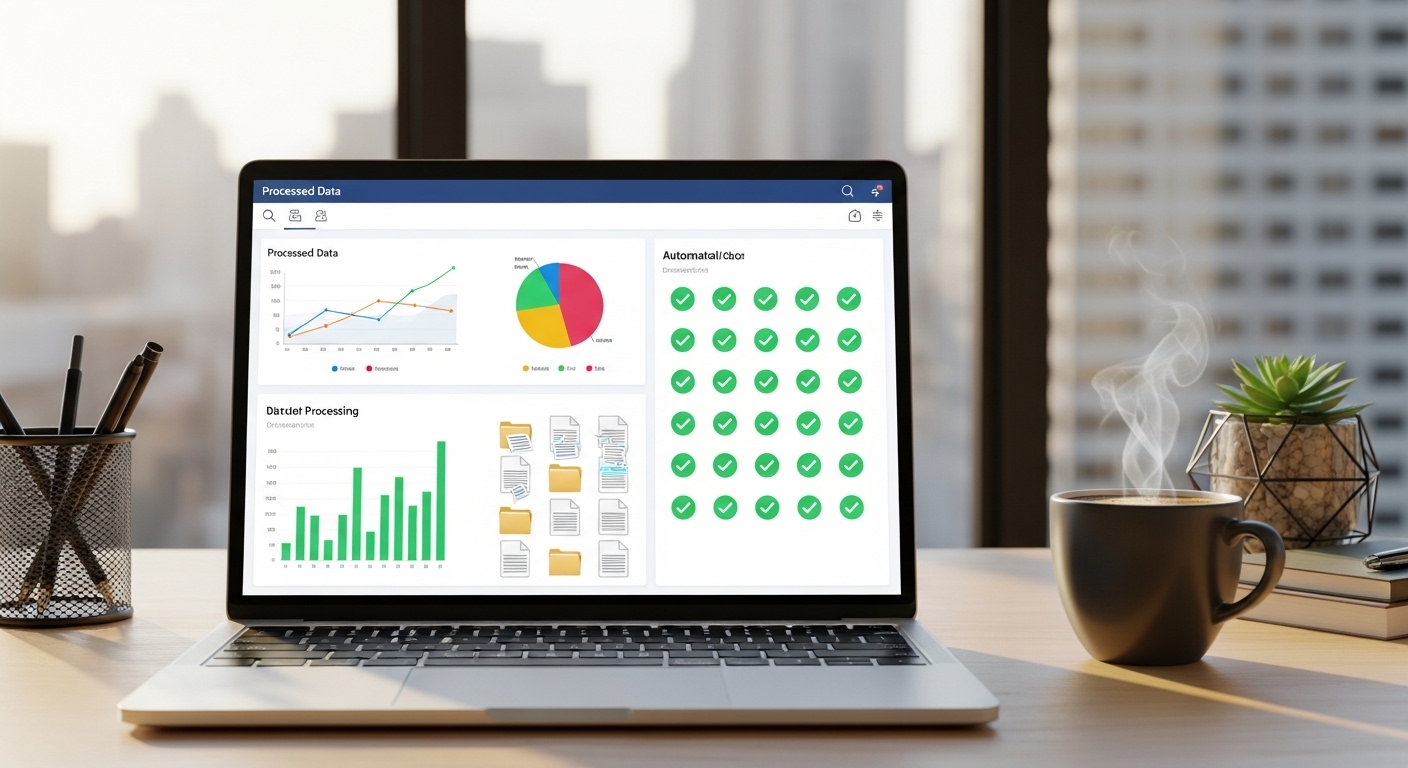
If you work in sustainability, you already know where most of your time goes. It's not strategy. It's not analysis. It's not even reporting. It's data collection.
Chasing invoices from accounts payable. Following up with site managers for fuel dockets. Logging into six different energy retailer portals to download electricity bills. Emailing procurement for the latest material purchase orders. Waiting three weeks for a supplier to send through their delivery notes. Then opening each document one by one, finding the consumption figure, converting the units, and typing it into a spreadsheet.
The CEFC estimates that data collection and processing consumes 60-80% of the total effort in corporate emissions reporting. For most sustainability teams, reporting season isn't about calculating emissions. It's about finding the data to calculate them from.
And the workload is about to ramp up significantly. ASRS Group 2 mandatory reporting started from July 2026, pulling hundreds more companies into scope. NGER reports are due every October. The Clean Energy Regulator isn't getting more lenient. But team sizes haven't grown. Budgets haven't doubled. The same two or three people who were already drowning in data collection are now expected to produce auditable, assured climate disclosures across Scope 1, 2, and 3.
Something has to give. We think autonomous AI agents are what makes this workload manageable.
The Data Collection Problem Nobody Budgets For
Carbon accounting has a dirty secret. The actual science - applying emission factors, calculating CO2-equivalent, categorising by scope - is fairly straightforward. The GHG Protocol published the methodology decades ago. The NGA Factors workbook gives you the numbers. A competent analyst can do the maths in their head.
The hard part is getting the data in the first place - and it takes an absurd amount of time.
A typical mid-market company with 30 sites generates somewhere around 1,500 to 3,000 source documents per year. Not just utility bills. Electricity invoices, natural gas statements, water consumption records, waste disposal manifests, fuel card transaction reports, bulk fuel delivery dockets, fleet management summaries, equipment hire invoices with embedded fuel charges, refrigerant top-up logs, material purchase orders, concrete delivery notes, steel and timber receipts, chemical safety data sheets with embedded quantities, logistics and freight invoices, travel booking confirmations, rental car receipts, accommodation bills for Scope 3 business travel, courier and postage records, and supplier invoices that bundle three different emission-relevant items into a single line.
They arrive as PDFs, scanned images, CSV exports from different portals, Excel attachments from suppliers, Word documents, photos taken on someone's phone at a remote site, and emails with the data buried in the body text. Every energy retailer formats their invoices differently. AGL doesn't look like Origin. Origin doesn't look like EnergyAustralia. And suppliers all format their paperwork differently too.
The GHG Protocol acknowledges that 83% of companies reporting climate disclosures struggle to access relevant emissions data. That's not a technology problem or a knowledge problem. It's a logistics problem. The data exists. It's sitting in email inboxes, SharePoint folders, cloud drives, supplier filing systems, and accounts payable platforms. The gap is getting it from where it sits to where it needs to be - and that gap consumes most of the reporting timeline.
Manual data entry error rates sit around 1-4% under normal conditions, according to multiple data quality studies. But carbon accounting isn't normal conditions. You're dealing with inconsistent units (kWh versus MWh versus GJ), overlapping billing periods, estimated reads mixed with actual reads, consumption figures buried between rate schedules and demand charges, and suppliers who send different information in different formats every quarter. The real error rate is almost certainly higher. The ANAO's audit of the NGER scheme found that 72% of 545 reports contained errors, with 17% containing significant errors. That's not a rounding issue. That's a systemic data quality failure driven by the sheer difficulty of collecting clean source data.
What an Autonomous AI Agent Actually Does
The term "AI agent" gets thrown around a lot. Most of the time it just means "chatbot with extra steps." But an autonomous agent in the carbon accounting context is something genuinely different. It's software that can independently perform a multi-step task - scan a folder of documents, extract the right data fields, match them to emission factors, calculate the emissions, check its own work, and flag anything uncertain - without a human touching it at any point during execution.
Here's what that looks like in practice.
You point the agent at a cloud storage folder - OneDrive, SharePoint, wherever your team currently stores invoices and source documents. The agent monitors that folder on a schedule you set: every fifteen minutes, hourly, daily, or weekly. When a new document lands, it picks it up automatically. No human has to remember to upload it to a second system.
But the folder isn't the only intake channel. Suppliers can email documents directly to a project-specific inbox. Each project gets its own email address with an authorised sender list. When a supplier sends their delivery note or invoice to that address, the agent picks it up the same way it picks up files from cloud storage. This solves one of the biggest time sinks in data collection - chasing suppliers for their paperwork. Instead of your sustainability team emailing suppliers, waiting two weeks, following up, and manually downloading attachments, the supplier just sends the document to an email address and the system handles the rest.
The agent reads each document - whether it's a PDF electricity bill, an Excel fuel card export, a scanned image of a handwritten docket, a Word document from a supplier, or a CSV data dump from a fleet management platform. It understands layout, context, and which numbers matter. If it's an electricity bill, it finds the total consumption in kWh, the billing period, the meter number, and the account details. If it's a diesel fuel receipt, it pulls litres, fuel type, date, and supplier. If it's a waste disposal manifest, it identifies the waste category and tonnage. If it's a material purchase order, it extracts quantities and product descriptions. If it's a refrigerant service log, it finds the gas type and kilograms topped up.
Then it applies the correct emission factor. For Australian companies, that means the NGA Factors - which vary by state, fuel type, year, and scope. Victoria's grid emission factor (0.78 kg CO2-e per kWh) is nearly four times Tasmania's (0.20). The agent knows this. It knows the difference between Scope 2 and Scope 3 electricity factors. It knows that diesel has an energy content of 38.6 GJ per kilolitre and a Scope 1 factor of approximately 2.7 kg CO2-e per litre. For materials, it runs through a multi-tier matching process - checking direct matches first, then known aliases, then AI-assisted context matching, then fuzzy matching - to find the right emission factor for each extracted item.
But here's where it gets interesting. The agent doesn't just extract and calculate. It checks its own work.
Confidence Scoring and Self-Verification
Every extraction gets a confidence score. Think of it like the agent raising its hand and saying "I'm 97% sure this electricity bill shows 12,450 kWh for July to September" versus "I'm 62% sure this handwritten fuel docket says 340 litres of diesel, but the handwriting is rough and I might be reading the 4 as a 9."
That distinction matters enormously for audit readiness. Under AASB S2, your climate disclosures will face assurance - limited assurance from year one, moving toward reasonable assurance. Your auditor will ask how you determined the emissions figure for a given facility. If the answer is "someone typed it from a PDF and we didn't check," that's a finding. If the answer is "an AI agent extracted it with 97% confidence, linked to the source document, and a human reviewer confirmed it," that's an audit trail.
The confidence scoring also drives intelligent triage. High-confidence extractions (say, above 90%) can flow straight through to the emissions ledger for human review. Low-confidence items get flagged for immediate attention. Potential duplicates - same invoice number, same amount, same date, different upload source - get caught before they corrupt your dataset.
No system can hit 100% accuracy on every document type. Handwritten fuel dockets from remote sites are genuinely hard. Scanned receipts with coffee stains and faded ink are genuinely hard. A material description that says "28MPa GP" needs the system to know that's general-purpose concrete at 28 megapascal strength, not just a random string. But the point isn't perfection. The point is that the agent handles the 85-90% of documents that are clean and straightforward, flags the 10-15% that need human judgement, and creates a complete audit trail for all of it.
Duplicate Detection: The Problem Nobody Budgets For
Here's something that doesn't get enough attention. Duplicate data is one of the most common sources of overreported emissions in manual systems.
It happens all the time. A site manager emails the electricity bill to the sustainability team. The accounts payable team also uploads it to the shared drive as part of their invoice processing. Someone downloads it from the retailer's portal for good measure. Now you've got the same bill counted three times. Your Scope 2 figure just tripled for that site for that quarter, and nobody notices because the numbers are buried across different worksheets.
An autonomous agent can catch this. It compares incoming documents against what's already been processed - matching invoice numbers, dollar amounts, billing periods, meter identifiers. When it spots a likely duplicate, it flags it rather than silently processing it again. You'd be surprised how many organisations discover 5-10% of their emissions data is duplicated once they actually check.
This matters especially for companies approaching NGER thresholds. If your corporate group is near the 50 kt CO2-e boundary, a few duplicated electricity bills across your facilities could be the difference between triggering mandatory reporting and not. Getting the data right isn't just about accuracy for its own sake. It has direct regulatory consequences.
Human-in-the-Loop: Governance, Not Bottleneck
The phrase "human-in-the-loop" gets used in AI marketing to make people feel safe. But in carbon accounting, it has a specific and important meaning.
The autonomous agent does the grunt work. It processes documents overnight. It calculates emissions. It flags anomalies. But it doesn't make final decisions. When your sustainability manager arrives at work in the morning, they don't face a pile of 200 unprocessed invoices. They face a dashboard of pre-processed results, sorted by confidence level, with anomalies and duplicates already flagged.
Their job shifts from data entry to data governance. Review the flagged items. Confirm or correct the low-confidence extractions. Approve the batch. That's a fundamentally different role. And it's the right role for a qualified human to play.
This matters for ASRS compliance specifically. AASB S2 requires organisations to describe their process for identifying and assessing climate-related risks. Auditors under ASSA 5010 will test whether your data collection process has appropriate controls. An autonomous agent with human review is a control. A sustainability analyst copying numbers from PDFs at 11pm before the reporting deadline is not.
The governance model also means you can set approval thresholds. Maybe anything above 95% confidence auto-approves into a review queue, while anything below 80% requires manual re-extraction from the source document. Maybe certain categories - Scope 3 supplier data, for instance - always require human sign-off regardless of confidence. The point is that the human decides the rules, and the agent follows them.
This also transforms how you work with suppliers. Instead of your team spending weeks chasing supplier data - which is often the single biggest time sink in Scope 3 reporting - suppliers can email their invoices, delivery notes, and consumption data directly to a project-specific email address. The agent processes what arrives, flags what's missing, and your team can see which suppliers have submitted and which haven't. The data collection problem shifts from "please send me your data" to "the data is here, let me review it."
What Changes for the Reporting Cycle
Let's be concrete about what this means for an Australian company preparing NGER and ASRS disclosures.
Under the old model, the reporting cycle typically looks like this: spend weeks collecting documents from across the business. Spend more weeks entering data into spreadsheets. Spend a few days doing quality checks (if you're thorough). Discover errors. Chase down the original documents. Correct the spreadsheet. Calculate emissions. Format the report. Submit. Hope nobody asks questions.
The whole cycle takes 8-12 weeks for a mid-market company. Larger organisations with multiple facilities can spend months.
Under the autonomous agent model, documents flow in continuously. The agent processes them as they arrive. By month-end, your emissions data is already calculated and sitting in a review queue. Your sustainability manager spends a few hours reviewing flagged items rather than weeks on data entry. The quarterly emissions figure is available within days of the quarter closing, not weeks.
And because every extraction links back to the source document, you've got your audit trail built in real time. When your ASRS auditor asks for the source documentation behind the Scope 2 figure for your Melbourne office, you don't have to go digging through shared drives. The agent already linked the original electricity bill to the calculated emission, with the factor version, the calculation methodology, and the confidence score all attached.
NGER reporting - due 31 October every year with no extensions - becomes a matter of exporting data that's already been processed and reviewed, rather than a three-month scramble that consumes your entire team.
The Honest Limitations
We'd be lying if we said autonomous agents solve everything. They don't. Here's where the gaps still exist.
Scope 3 remains genuinely difficult. Categories like purchased goods and services (Category 1) or use of sold products (Category 11) depend on supplier data that is often unavailable, inconsistent, or requires spend-based estimation with 30-40% error margins. An agent can process supplier invoices and apply spend-based factors, but the underlying accuracy problem doesn't disappear just because the processing is automated.
Document quality varies wildly. A clean digital PDF from AGL processes perfectly. A photo of a handwritten fuel docket taken in low light on a dusty construction site? That's still hard. AI vision models have improved enormously - but they're not magic. Truly illegible documents still need a human to pick up the phone and ask the supplier for a re-issue.
Emission factor updates require vigilance. The NGA Factors workbook gets updated annually by DCCEEW. State-based grid factors change as the generation mix shifts (South Australia's dropped from 0.23 to 0.22 between the 2024-25 and 2025-26 editions). The agent needs to use the right factors for the right reporting period. That's a solvable problem, but it requires someone to maintain the factor database and validate it against the published source.
And the NGER versus AASB S2 global warming potential discrepancy - NGER uses AR5 GWP values while AASB S2 technically requires AR6 - creates a real reconciliation headache. AASB S2025-1 provided jurisdictional relief so NGER reporters can use AR5 for NGER-covered portions, but you still need to know which portions that applies to. Autonomous agents can handle this bifurcation, but it needs to be configured correctly.
Where This Goes From Here
The technology to build autonomous carbon accounting agents exists today. Large language models can read documents with human-level comprehension. Cloud storage APIs allow continuous monitoring of document folders. Emission factor databases are published and structured. The pieces are all there.
What's changing in 2026 and 2027 is the regulatory pressure that makes this shift from "nice to have" to "how else are we going to get this done." ASRS Group 2 is live. Group 3 starts from July 2027. The Clean Energy Regulator is increasing scrutiny on NGER data quality. The ACCC has made clear that inaccurate environmental claims carry real penalties - $50 million or more for listed corporations.
The sustainability teams who adapt earliest won't just save time. They'll produce better data. They'll have stronger audit trails. They'll spend their days on strategy and reduction rather than data entry and spreadsheet management.
And they'll probably sleep better knowing that while they were at home, their data was being processed, checked, and prepared for their review in the morning.
That's not science fiction. That's just what happens when you stop treating carbon accounting as a manual data entry task and start treating it as an automation problem.
Related reading:
- Why Spreadsheets Are Killing Your Carbon Reporting - the case for moving beyond Excel before your next reporting cycle
- How to Calculate Scope 2 Emissions from Electricity Bills - the step-by-step methodology with NGA Factors
- NGER Compliance: What the Clean Energy Regulator Actually Checks - enforcement patterns, penalties, and what Beach Energy's enforceable undertaking means for you
- Australian Emission Factors (NGA) Explained - state-by-state grid factors and why using the wrong one is a compliance risk